
Before ordering compostable cups, confirm where the used cups will actually go. The key question is whether your collection service takes that exact product to a facility that accepts it. A compostable label describes a product capability under suitable conditions; it does not, by itself, create a working disposal route for your office.
Start with the receiving facility
EPA advises purchasing certified commercially compostable foodservice ware only when a local composting program accepts the product types and collection or hauling is arranged. It also notes that some commercial composting facilities do not accept compostable products. A food-scrap collection program is therefore not sufficient evidence that its processor accepts cups.
Ask the hauler to identify the facility receiving your material and provide its current acceptance requirements. Then check the proposed cup, lid and collection liner against those requirements. Written confirmation tied to the actual product is more useful than a broad statement that a service “does composting.”
Keep the confirmation with the purchasing specification. If a product substitution or hauling arrangement changes, repeat the check rather than assuming the old answer still applies.
Certification and local acceptance answer different questions
A compostability certification can help substantiate the product’s performance under the conditions covered by that certification. The local facility still decides which products its operation accepts. Both checks matter, and passing one does not establish the other.
Check whether the product is intended for commercial composting or home composting. EPA explains that many compostable plastic products require industrial treatment and will not break down in a landfill, a home compost pile or the environment. Do not infer a disposal outcome from the cup’s appearance, a leaf graphic or a general “plant-based” claim.
Compostable plastic also does not belong automatically in conventional plastics recycling. EPA warns that it can contaminate and disrupt that stream. A familiar-looking clear cup can therefore require a different route from a conventional plastic cup beside it.
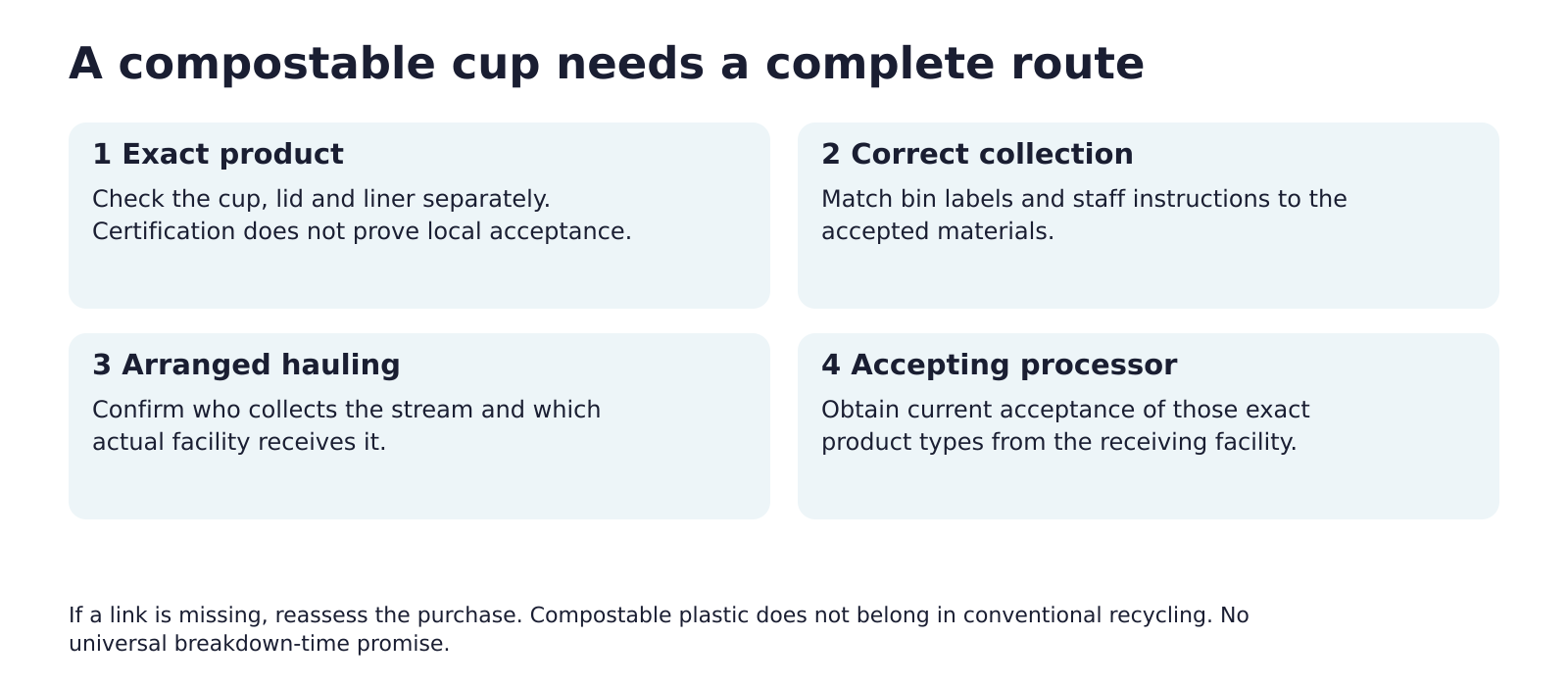
Select the infographic to open it at full size. The article also explains the comparison in text.
Treat the cup and lid as a purchasing system
A cup may be accepted while its lid is not. The same goes for a collection liner. Ask for the product identity and relevant certification of each component, then verify acceptance with the receiving program. Record hot- or cold-drink suitability, lid fit and the sizes people need separately from the disposal checks.
That prevents a practical mismatch: a purchasing team approves one cup, someone substitutes an apparently similar lid and the disposal instructions no longer describe the complete item. Use standardized procurement to capture the approved combination and the conditions under which a substitute is acceptable.
The approved list should be specific enough for the people ordering foodservice and breakroom supplies to follow without having to re-interpret a marketing claim each time.
Build the collection route inside the office
Even an accepted cup needs to reach the right collection stream. Put clear, locally accurate instructions where people finish their drinks. Show the actual products in use where practical, and make the alternative waste streams easy to distinguish. Do not use a generic compost poster that includes items your processor rejects.
Give cleaning staff the same instructions. Confirm which liners are used, who checks for obvious contamination and how bags stay separated during collection. Ask the hauler what happens when a load is rejected, and account for storage, collection frequency and any added charges before changing the order.
A small pilot can expose confusion before the whole building switches. Check the bins, confirm pickup and ask whether the receiving facility accepted the material. Buying a certified product and putting a new container in the breakroom are important steps, but neither verifies the completed route.
If the route is missing, reconsider the purchase
A compostable option should not be selected on the assumption that it will compost when it is going into ordinary trash. EPA prefers reusable foodservice ware where an effective collection, washing and return system can operate. That is a system decision too: ownership, washing capacity and repeat use need to be workable.
If reuse is not practical for the setting, assess another option that fits the local waste program and applicable requirements. Avoid declaring one material universally better. A defensible environmental comparison would require evidence about the particular products, use patterns and end-of-life routes.
Keep janitorial collection supplies aligned with the approved cup program. The useful buying sequence is simple: verify the destination, approve the complete product combination, set up collection and then check that it works. The disposal route should be part of the purchase decision, not a question left for someone else after the cups arrive.