A floor scrubber’s purchase price is only the opening line of its budget. To understand what it costs to keep floors clean, include operating time, daily care, wear parts, chemicals, utilities, service and downtime. Keep that full cleaning-service cost separate from equipment ownership costs so nobody mistakes one for the other.
Define the cleaning job before comparing machines
Start with the floor and the route: the area to clean, surface, soil load, acceptable result and cleaning frequency. Then check the available storage, filling and emptying points, charging arrangements and access through the building. A machine that fits an open demonstration space may face a very different working day among furniture, narrow turns and occupied areas.
The useful question is how much time and expense the complete job requires at your site. Catalog coverage figures alone cannot answer it. Time a representative route from equipment pickup to put-away, including travel, refills, edge work, any pre-sweeping and end-of-use care. Keep those activities separate so you can see what a different machine or process would actually change.
Maintenance is part of the work
Primary equipment documentation makes the point concrete. A June 2025 manufacturer operator manual reviewed for this article lists daily attention to pads or brushes, the squeegee, tanks and charging, plus additional checks tied to operating hours. It also distinguishes operator tasks from trained-person service. Those requirements support budgeting for care; the exact intervals apply to that documented model, not every scrubber.
Battery type matters too. The same manual explains that sealed AGM batteries do not require watering, while still requiring other maintenance. Ask for the instructions for the actual battery and charger configuration being quoted. “Maintenance-free” on a battery does not mean the whole machine can be parked dirty and ignored.
Build compatible pads, brushes, squeegee blades and cleaning chemistry into your janitorial supply planning. Obtain the maintenance schedule before purchase and decide who performs each task. A low annual service allowance is not a substitute for assigning the daily work.
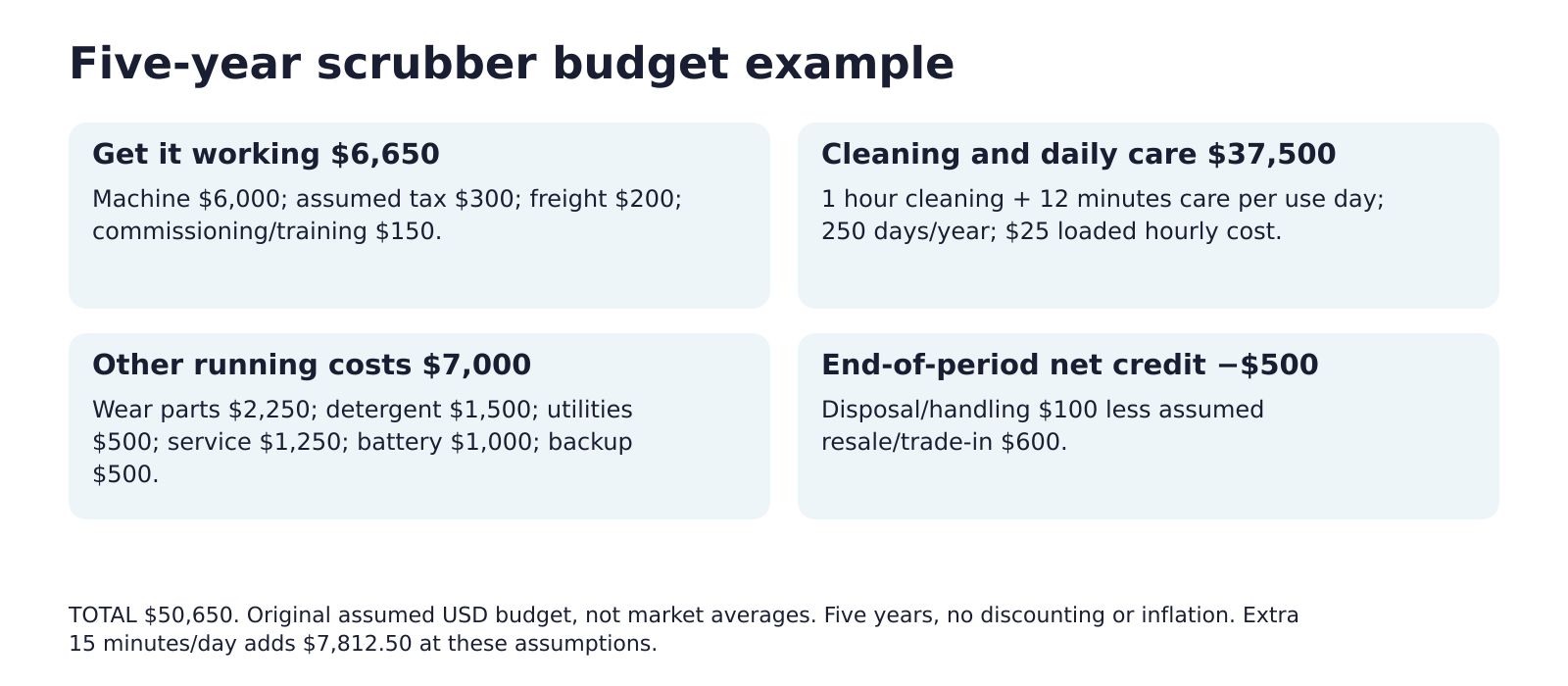
Select the infographic to open it at full size. The article also explains the comparison in text.
An illustrative five-year cost breakdown
The example below uses a manually operated battery scrubber for 250 days a year over five years. All prices and operating inputs are assumptions in U.S. dollars, not supplier quotes, measured market averages or promised results. The model uses constant dollars without discounting and excludes financing, inflation and income-tax effects.
Cleaning takes an assumed one hour per use day. Separate setup and end-of-use care take another 12 minutes. Both use an assumed loaded labor rate of $25 an hour. That rate is a budgeting input, not a national wage figure. For context, BLS reports a May 2025 median wage of $17.71 an hour for janitors and building cleaners; an hourly wage is not a fully loaded employer cost or contractor bill rate.
| Five-year budget item | Assumed calculation | Cost |
|---|---|---|
| Machine | Initial purchase | $6,000 |
| Tax, freight, commissioning/training | $300 + $200 + $150 | $650 |
| Cleaning labor | 1 hour × 250 days × 5 years × $25 | $31,250 |
| Setup and daily-care labor | 0.2 hour × 250 days × 5 years × $25 | $6,250 |
| Pads, brushes and squeegee wear parts | $450 a year × 5 | $2,250 |
| Detergent | $300 a year × 5 | $1,500 |
| Electricity, water and sewer | $100 a year × 5 | $500 |
| Planned professional service | $250 a year × 5 | $1,250 |
| One installed battery replacement | Assumed event within the period | $1,000 |
| Incremental downtime backup/rental | Assumed period allowance | $500 |
| End-of-period disposal/handling | Assumed handling cost | $100 |
| End-of-period resale/trade-in credit | Assumed residual value | −$600 |
| Total including operating labor | Five-year illustrative budget | $50,650 |
What that $50,650 does and does not mean
In this example, cleaning and daily-care labor total $37,500. The other budget items total $13,150, including the initial commissioning/training allowance. That split is the result of these particular assumptions; it is not a published industry cost ratio.
The $50,650 also is not the extra cost of choosing a scrubber over a mop or another machine. The alternative still requires supplies, labor and a way to achieve the same cleaning result. Build an equivalent model for each option before calling the difference a saving. If labor hours are freed up but payroll does not change, describe the benefit as available capacity unless there is a real cash reduction.
Keep the accounting consistent. Cleaning time here excludes the separately listed daily care. Professional service excludes the wear parts and battery replacement already budgeted. The backup allowance is incremental to ordinary labor. The battery replacement is an assumed event, not a guarantee or universal lifespan. Change the inputs to match the proposed configuration and your service history.
Test the assumptions that can change the decision
An extra 15 minutes per use day over 1,250 days adds 312.5 hours. At the assumed $25 loaded rate, that adds $7,812.50. That arithmetic explains why measuring the route can be more useful than negotiating only the purchase price. It does not show that any machine will save 15 minutes.
Run a low, expected and high case for working time, frequency, service and battery expense. Use an actual battery replacement quote, and check what installation and disposal it includes. Price wear parts against the intended floor and workload rather than assigning them an unsupported universal replacement interval.
Measure charging energy where practical and use local electricity, water and sewer rates. Battery capacity alone does not establish the cost at the wall. For a per-area comparison, divide the relevant total cost by the total area cleaned during the same period and multiply by 1,000 for cost per 1,000 square feet. Both options must deliver comparable cleaning quality.
Make the operating budget part of the purchase file
Ask for a complete equipment and accessory quote, battery and charger details, maintenance responsibilities, consumable prices, warranty exclusions and expected service response. Record a backup plan for a breakdown. A warranty may cover a component without eliminating disruption or every associated cost.
Use standardized procurement to keep the approved machine, supplies and purchasing specifications aligned. Where stocking is the problem, consider how vendor-managed inventory could fit the replenishment process. Neither replaces a site-specific equipment evaluation.
The best purchase file makes the ongoing work visible before approval. It tells the operator what to do, the buyer what must stay available and finance which assumptions need watching. The purchase price still matters. It just needs the rest of the budget beside it.