Neither desk-side trash cans nor central waste stations are the automatic winner for every office. The better system makes correct sorting convenient, accommodates the people using it and gives cleaning staff a manageable collection route. Before buying bins, decide both where waste goes and who is responsible for moving it there.
Two decisions that often get mixed together
Bin location and collection service are separate choices. An office can keep small containers at desks while asking employees to empty them into shared stations. It can also provide central stations while retaining individual collection where access needs require it. Removing custodial desk-side service does not necessarily require removing every desk-side container.
That distinction changes the cost discussion. Fewer custodial stops may simplify a route, but some handling shifts to occupants. Count that change honestly rather than calling every minute removed from the cleaning schedule a net saving for the organization.
The case for desk-side bins
Desk-side collection offers immediate convenience. It can suit workstations where leaving frequently is difficult and can form part of an accessibility accommodation. Paired trash and recycling containers also give users a sorting choice at the point where waste is generated.
The drawback is the number of service points when custodians empty every container. Depending on policy, that can mean more liners and more repeated handling. A large trash can with no equally convenient recycling option may also make correct sorting harder. These are layout and service questions, not proof that all desk-side systems perform poorly.
In fact, a 2014 study by Action Research, commissioned by Keep America Beautiful and sponsored by PepsiCo Recycling, tested four arrangements across 34 offices. Its fact sheet favored a small trash bin attached to a desk-side recycling bin. The study did not establish that every desk-side system beats every possible central-station design.
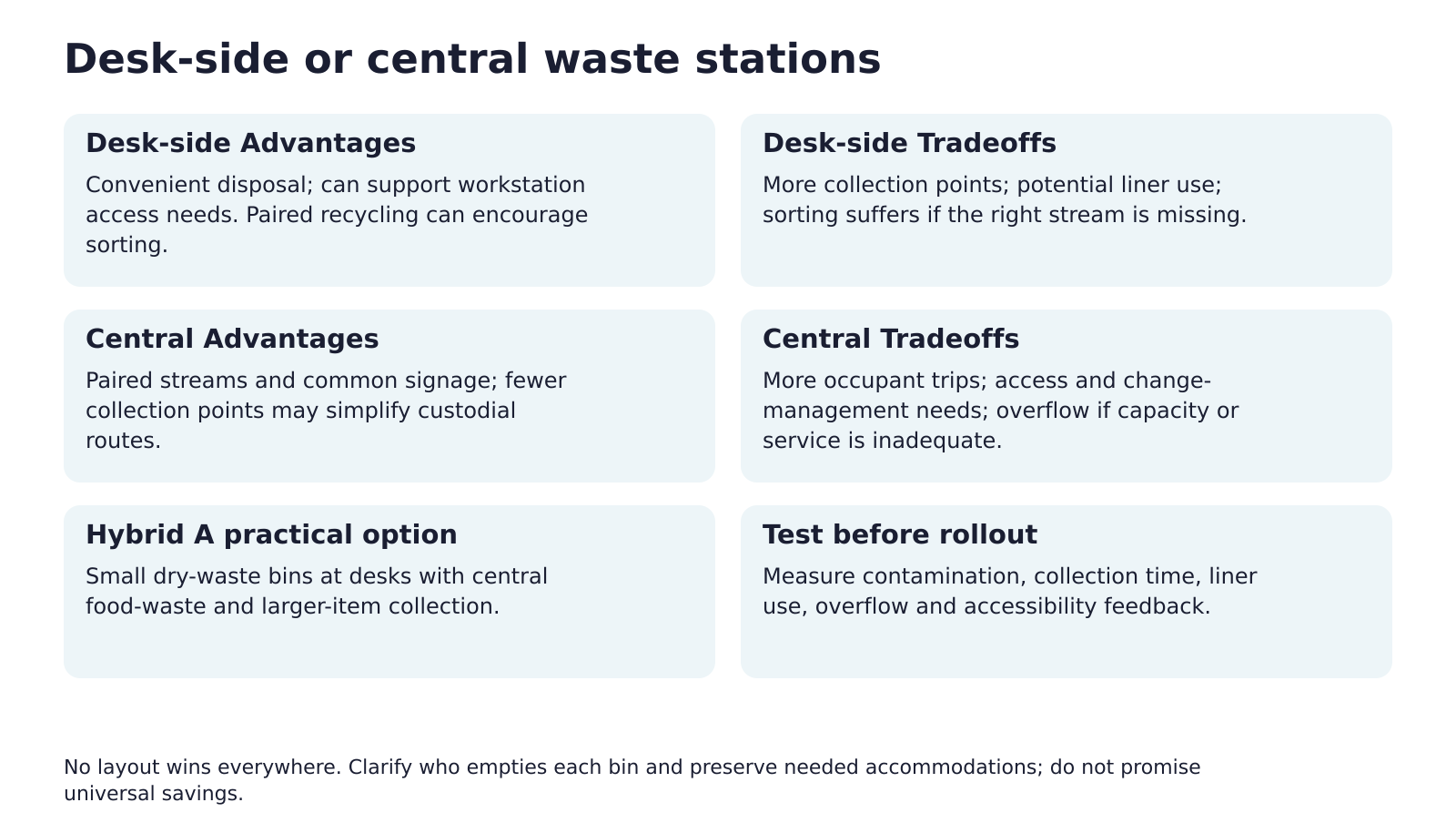
Select the infographic to open it at full size. The article also explains the comparison in text.
The case for central stations
Shared stations put the available waste streams together and create a consistent place for labels. They can reduce the number of custodial collection points and concentrate food disposal away from desks. Stanford reported improved recycling rates in its shared-station pilots, supporting the approach as a credible option.
That campus experience is not a guaranteed result for another office. Placement, education, waste streams and collection arrangements all matter. A station around a corner may be convenient for one group and a barrier for another. An undersized station can concentrate overflow and odor instead of solving them.
Central collection therefore needs an operating plan: enough capacity, clear responsibility for servicing, a sensible food-waste schedule and access accommodations. UCLA’s published central-collection guidance explicitly retains accommodation exceptions. Do not turn a purchasing standard into a blanket rule that overlooks the people using the building.
A hybrid can be the practical middle ground
A small desk-side container for dry everyday waste, paired with recycling and emptied into central stations, preserves some convenience without requiring a full custodial stop at every desk. University of Iowa’s Tiny Trash program uses this approach and directs messy waste to central bins to help avoid odors and pests.
The hybrid still needs clear instructions. Employees should know which containers they empty, where food belongs and whether desk liners are provided. Cleaners need the same accepted-material list and service expectations. Confidential paper, batteries and other special waste need their own approved routes; they should not be folded casually into an ordinary office-bin plan.
Pilot the layout before buying it for the whole building
Choose a representative area and record a baseline. Then test the proposed layout under comparable occupancy and collection frequency. Keep track of any education changes too, so a new poster campaign is not mistaken for the effect of a different bin.
Use the results to answer the purchasing question, not just to produce a recycling headline. Check whether materials reach the correct stream, whether stations stay usable and whether the service workload makes sense.
- Measure contamination and captured recyclables consistently, by weight or count.
- Count liners and custodial servicing time, while noting occupant handling.
- Record overflow, odor complaints and access concerns.
- Confirm station capacity and collection frequency before expanding.
Buy for the collection system you intend to run
Use janitorial supply planning to match containers, liners and routine supplies to the agreed layout. Then document the approved sizes, labels and responsibilities through standardized procurement, so replacement purchases do not gradually undo the system.
The right answer may be desk-side service, central collection or a hybrid across different parts of the same building. A short pilot and a clear service agreement provide a stronger basis for that choice than assuming one bin arrangement always costs less or produces better recycling.