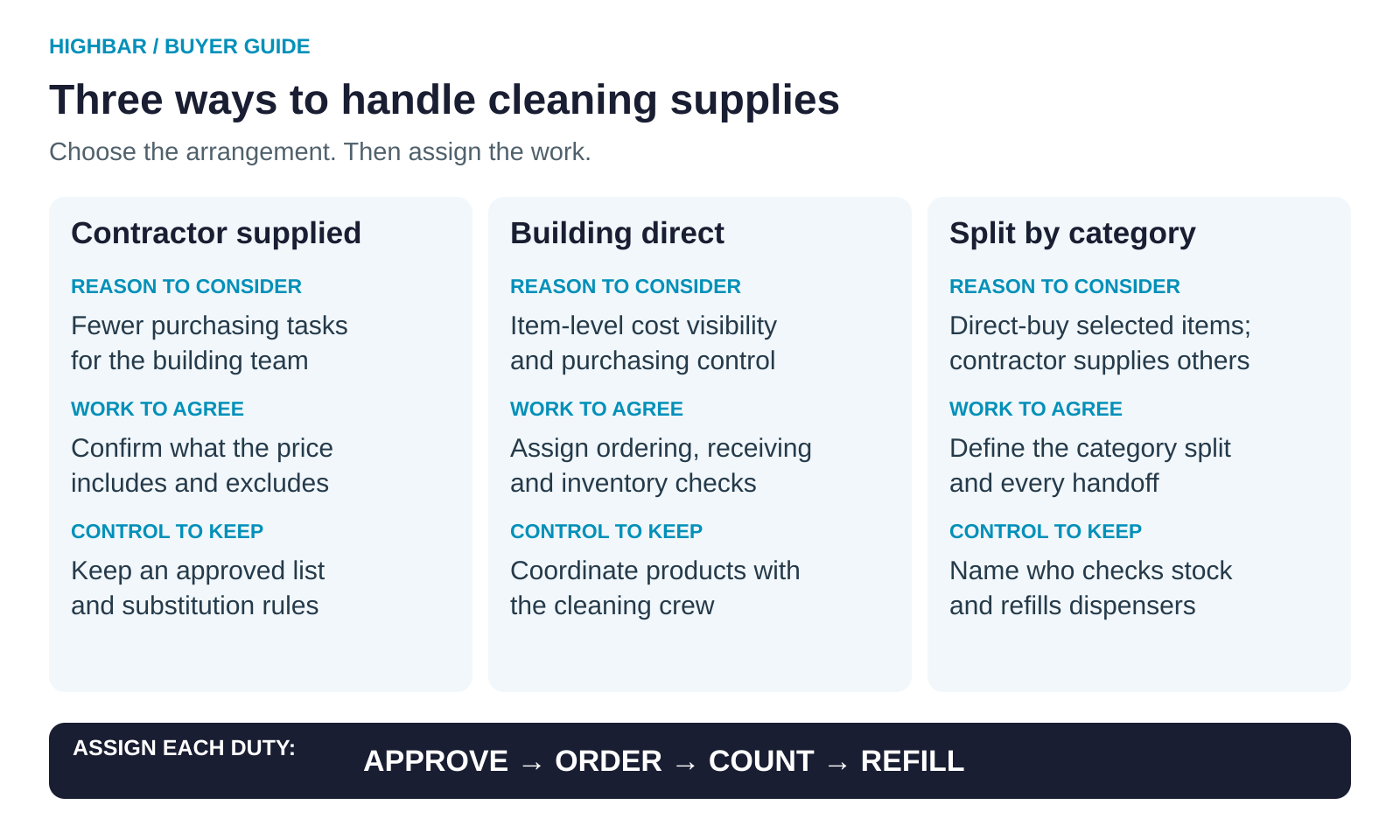
Buy your own supplies when control over the product list and item-level spending is worth the ordering and inventory work. Let your cleaning company supply them when keeping those responsibilities in the service agreement is more valuable. A hybrid can work when you want to choose the building's paper and soap while leaving cleaning chemicals and equipment with the contractor.
The right answer depends on the actual prices, the work included and who can handle that work reliably. Separate four decisions before choosing: who approves products, who buys them, who checks inventory and who refills dispensers.
First, agree on what “supplies” includes
Paper towels, toilet tissue and hand soap serve the people using your building. Floor cleaner, mop heads and cleaning equipment support the crew doing the work. Trash liners may fall on either side of the agreement.
Start with a category-by-category list. A quote that includes cleaning chemicals but excludes restroom consumables covers a different job from one that includes both. Ask about quantities or allowances, extra charges and how product substitutions are handled. Match paper and soap to the dispensers already installed.
That list also makes it easier to compare janitorial supplies without accidentally changing the products or service you're evaluating.
When contractor-supplied makes sense
There is value in having one company responsible for the cleaning service and its supplies. A contractor may already have purchasing arrangements, an inventory routine and a crew trained to use its products. If your office has little capacity for another ordering process, keeping those tasks together may be worth paying for.
Ask what the service actually covers. Does the contractor monitor the stockroom and place orders, or simply bring products when the crew arrives? How are changes in occupancy or usage handled? Is the price fixed, based on consumption or subject to an allowance?
You can also retain product approval. The University of New Orleans' 2025–2026 custodial solicitation required contractor-provided supplies, including restroom consumables, while reserving university approval over products. Contractor purchasing and building control can coexist.
The trade-off is visibility. A bundled quote may provide less item-level detail than direct invoices. Decide whether you need that detail, then ask for the reporting or pricing breakdown you need before agreeing to the arrangement.
When buying directly makes sense
Direct purchasing puts the supply orders and invoices in your hands. That can be useful when you want an approved product list, need spending assigned to individual locations or already have a purchasing process that can handle the building's consumables.
It also leaves work to assign. Someone must order, receive deliveries, review invoices and keep track of stock unless you arrange for another party to do those jobs. A lower supply quote should be weighed against that workload.
Keep the cleaning company involved in product decisions. A different floor-care product or chemical may change the crew's equipment, dilution or work requirements. Review proposed changes with the contractor before ordering. For paper and soap, confirm the exact refill and dispenser fit rather than relying on a broad description such as “standard roll.”
A hybrid can divide the work sensibly
You might buy restroom paper and hand soap directly while the cleaning company supplies its chemicals, tools and equipment. The contractor can still refill the dispensers with your products if that work is included in its scope.
A 2025 City of Mobile bid addendum used that division: the city would provide specified paper products and hand soap, and the vendor would continue restocking them while providing other cleaning supplies. The specification shows how buying and restocking can be assigned separately.
The practical advantage is flexibility. You can keep purchasing control where it matters to you and leave crew-specific products with the people using them. The trade-off is another handoff to manage. Write down the category split, including easily overlooked items such as liners, batteries and dispenser maintenance.
Compare the revised contract, not an assumed markup
Before moving supplies out of a cleaning agreement, get the contractor's actual revised service price. Then obtain a direct-purchase quote for the same products or agreed equivalents, expected quantities, locations and delivery requirements. Keep the cleaning schedule and work scope consistent.
Compare the total for the same period: the cleaning service, supplies, known delivery or other charges, and any additional purchasing or inventory work. Avoid counting work twice if it is already included in the contractor's fee.
The useful question is how much the total arrangement changes. A lower price on a case of towels doesn't establish savings if the cleaning-service price stays the same. Conversely, a contractor's efficient purchasing or a convenient bundled service may be valuable even if it offers less invoice detail.
Use your own order history to estimate quantities where it's available. Confirm case counts, roll lengths or sheet counts and other specifications so the comparison holds up. If the quotes aren't equivalent, resolve those differences before treating the price gap as a saving.
Make the stockroom-to-restroom handoff explicit
A stocked closet still needs someone to refill the dispenser. An overnight refill also doesn't answer who responds when supplies run low during the day. Put names or roles against these questions:
- Who checks stock, how often, and who places the next order?
- Who receives deliveries and reports missing or unsuitable products?
- Who refills during the day and during the cleaning shift?
- Who reports a shortage, arranges an emergency purchase and pays for it?
- What happens to remaining supplies if the cleaning contractor changes?
These answers matter in all three arrangements. Direct purchasing can leave the contractor responsible for stock checks. Contractor purchasing can still involve your staff in daytime refills. Agree on the duties rather than assuming the invoice tells the whole story.
Choose the arrangement that gives you the control you need at a total cost you understand, with responsibilities your team and contractor can carry out. If you're considering direct purchasing, contact Highbar with your product list and expected quantities. That gives the supply conversation a concrete starting point.
Sources
- University of New Orleans, 2025–2026 custodial solicitation, product approval and supply responsibilities, PDF pages 29 and 36
- City of Mobile, 2025 janitorial bid addendum, city-provided consumables and vendor restocking, page 1