Rent entrance mats when the service and circulating inventory solve an operating need at an acceptable total cost. Buy when your facility can reliably clean, dry, store, inspect and replace them. Compare those complete arrangements before deciding, then check that any rental charges match the agreement and the service actually provided.
A fair comparison begins with the same coverage, intended function and acceptable condition. A small purchased mat and a larger rental arrangement may not provide equivalent service. Map each entrance, the routes people actually take and the places where water or soil continues beyond the matting.
Inspect the entrance during use, including wet conditions. Check that mats stay in position, lie flat and remain suitable for the floor and traffic. Keep a response plan for wet tracking or damaged mats. OSHA’s walking-surface requirements call for regular and as-needed inspection and correction or guarding of hazards; a rental arrangement does not remove that responsibility.
A UK safety case study describes keeping spare entrance mats available, replacing wet matting and responding to water tracked onto the floor. It illustrates an operational requirement worth pricing into either option: what happens when a mat needs attention before the next scheduled cleaning or delivery?
Rental can combine access to mats with scheduled pickup, laundering and clean replacements. It may suit a facility that lacks drying space, spare inventory or staff capacity to manage the full cleaning cycle. Confirm which of those services the quoted price actually includes.
The facility still needs someone to inspect the entrance, report problems and verify deliveries. Routine cleaning between exchanges may also remain your responsibility. Ask what happens after a missed visit, when a delivered mat is unacceptable or when wet conditions require an extra exchange.
Specifications can be made explicit. A historical 2009 public university bid assigned delivery, placement, removal and cleaning duties to the contractor and required worn mats to be replaced with new or like-new ones without additional cost. That is an example of a defined purchasing requirement, not a promise contained in every rental contract.
Select the infographic to open it at full size. The article also explains the comparison in text.
Buying gives you direct control over the mat specification and replacement decision. It can suit a facility with appropriate equipment, storage and a dependable cleaning process. Include enough spare stock to keep the entrance covered while other mats are being cleaned and dried.
Check the manufacturer’s care instructions before deciding how you will maintain the mats. Identify who will do the work, where drying happens and how clean and dirty inventory will be handled. An owner also needs a retirement decision for mats that no longer lie flat or remain suitable for use.
A hybrid arrangement may be worth quoting: owned mats with outside cleaning, or a mix of owned and rented products serving different entrances. Compare its actual availability and costs rather than assuming it combines every advantage of both options.
Use the same locations, quantities, service level and comparison period for each option. A three-year worksheet can be useful if that fits your planning, but it is a chosen horizon, not a claim about a standard contract length. Count actual billing periods rather than treating every month as four weeks.
For rental, include the recurring charges plus applicable delivery, minimum-service, loss or damage, protection-program, emergency-exchange and customization charges. Add taxes, documented increases and any relevant renewal or exit costs. Subtract confirmed credits. Include the internal time spent receiving, checking and following up.
For ownership, include mats, freight, taxes, spare stock, cleaning labor, equipment or contracted cleaning, supplies, drying and storage, expected replacements and disposal. Staff time still has a cost even when the employees are already on payroll. Allocate shared equipment fairly instead of charging its full purchase cost to several different projects.
Use your quotes, invoices and workload measurements. Without those inputs, a universal savings percentage is not useful. Test the decision against changes that matter: more frequent cleaning, another entrance, higher labor requirements or additional wet-weather swaps.
Before disputing a charge, ask for its definition and contractual basis. A clean exchange, an added mat, a loss-or-damage charge and a recurring replacement-protection fee can represent different events. A recurring rental charge may relate to inventory remaining available at your facility rather than a new physical delivery that week.
That distinction does not excuse a missed exchange or an unexplained fee. It tells you which question to ask. If the invoice charges for a delivered replacement, request the delivery record. If it charges for loss or damage, request the affected item, reason, date and supporting record. If it is a program fee, check what protection it promises and what remains excluded.
Public complaints show why buyers want clearer records. In a December 2024 small-business discussion, one commenter wrote: “Also complained of being overcharged for mats I never received.” That is an unverified, pseudonymous account. It does not establish wrongdoing or how often a problem occurs. The useful response is to compare your own agreement, service records and bill.
Keep an approved list by location: mat type, dimensions, quantity, placement and service interval. Give receiving staff that list before the next visit. Record what arrives and leaves, including any shortages or condition issues, while the service can still be checked. The vendor’s ticket should not be the only check on the vendor’s work. Assign someone on your team to verify the exchange rather than relying solely on the route employee who records it.
The record should identify the visit date, location, quantities by type or size, exceptions and the person who checked them. Retain an itemized service ticket and relevant photographs where practical. Check what an electronic signature confirms before signing. If something is missing, have the exception recorded.
Use item identifiers when the vendor provides them. Photographs of similar-looking mats alone may not establish whether an exchange happened in a pooled rental system. Conversely, a ticket listing the expected quantity does not explain a discrepancy found during a physical count. The records need to be reconciled.
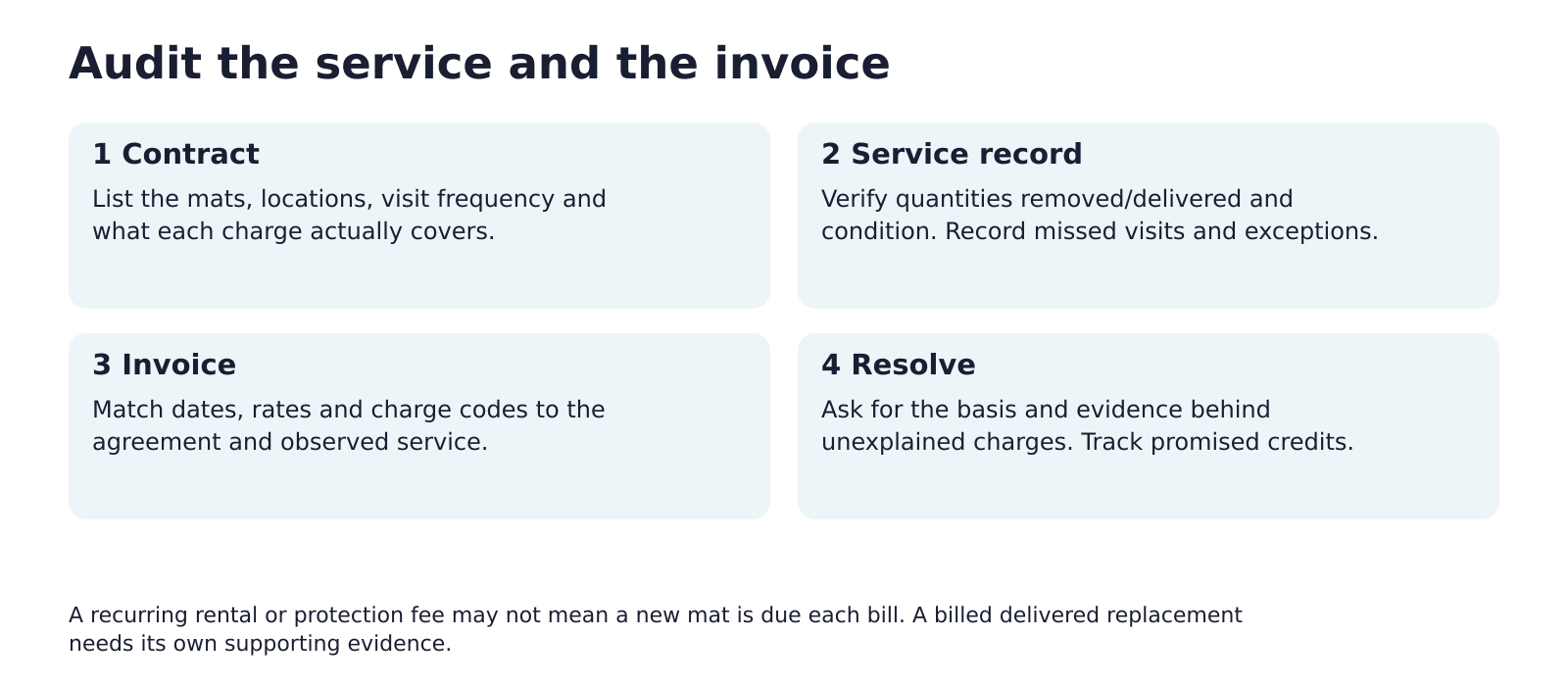
This three-way check gives each charge a basis: what was agreed, what was observed and what was billed. Federal procurement rules use receiving or acceptance documentation to support payment. Private businesses can adapt the recordkeeping principle without treating federal contract rules as their own legal obligations.
Send a focused request identifying the invoice, line item, service date and discrepancy. Ask for the contract provision or supporting record that explains the charge. If the records support a correction, request an itemized credit and a date for resolution. Keep the explanation with the invoice.
Track repeat issues separately from one-off mistakes. A continuing pattern of missed exchanges, incorrect quantities or unresolved credits belongs in the supplier review. Follow the agreement’s notice and dispute process and obtain appropriate advice before withholding payment or terminating a contract. A missed visit alone does not establish a universal right to cancel.
Before renewing, revisit service frequency, acceptable mat condition, authorized additions, change approval, price adjustments and notice dates. Make the requirements specific enough that a different employee could check the service without reconstructing the agreement from memory.
Rental earns its place when the agreed service is useful, consistently delivered and worth the full cost. Ownership earns its place when the cleaning, spare-stock and replacement plan is workable. Both need someone accountable for the entrance and the records.
Highbar’s guide to buying cleaning supplies or using a cleaning company explores the related operating decision. For the purchasing side, bring your mat specifications and maintenance requirements into a janitorial supplies discussion. A documented requirement and a comparable cost worksheet make either decision easier to defend.