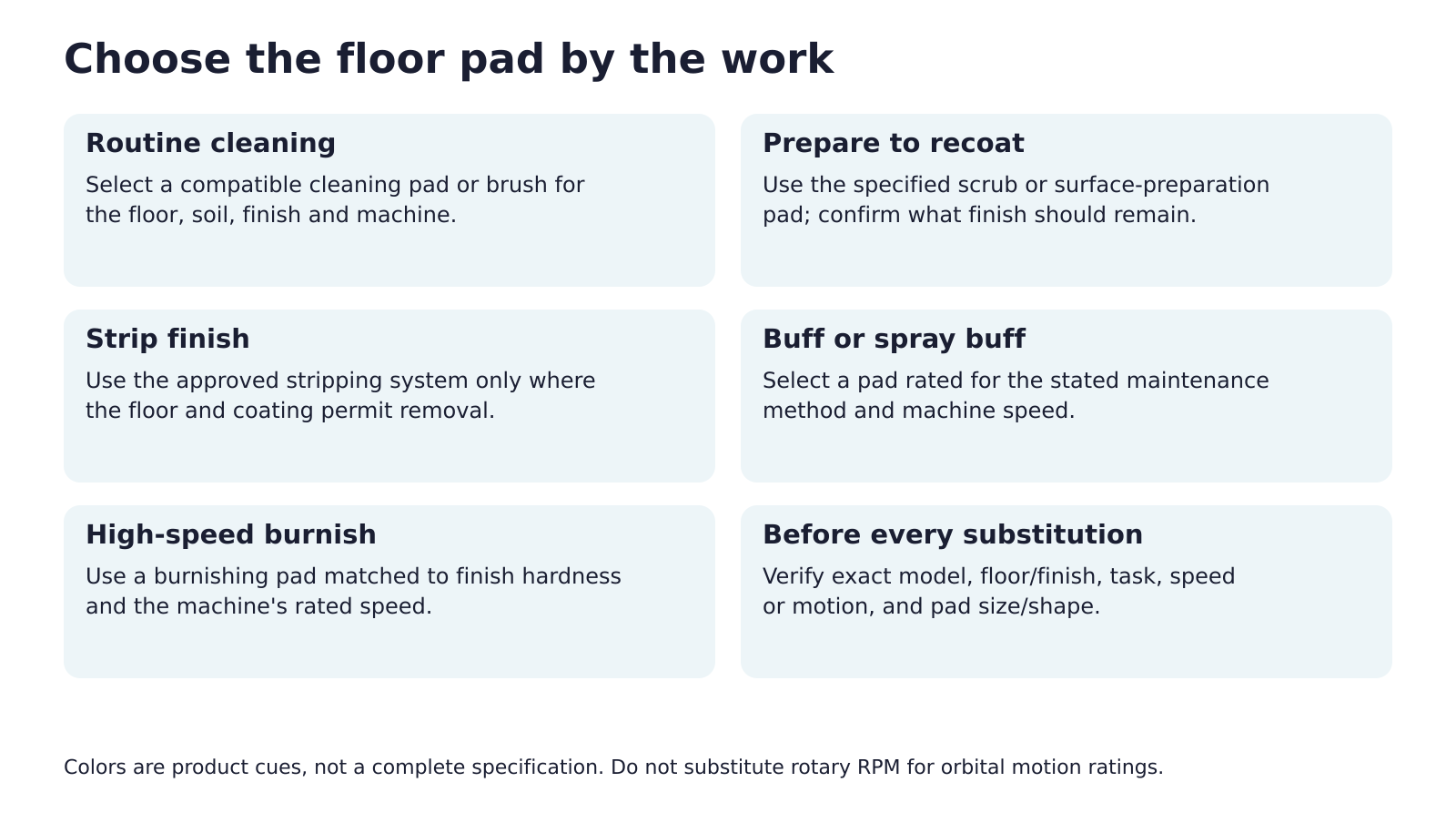
Order floor pads by the job, the floor and finish, the machine, the required dimensions and the exact approved product. Color can help identify a pad within a product line, but it cannot carry the whole purchasing specification. “Another case of blue pads” leaves too much for the next person to interpret.
Routine cleaning, preparing a floor for recoating, stripping, buffing and burnishing have different objectives. A purchase request should identify which result the operator is trying to achieve. Removing daily soil and deliberately removing finish are materially different jobs.
Ask the person responsible for floor care to describe the intended operation in plain language. Is the existing finish supposed to stay in place? Is the team preparing for another coat? Is the floor due for a more extensive restoration? That answer should be settled before purchasing chooses a pad.
Green Seal’s cleaning-service standard separates routine, periodic and restorative work. It also calls for enough finish to protect the flooring during periodic maintenance. The standard is voluntary, but the underlying purchasing lesson is useful: the floor’s current condition belongs in the decision.
“Hard floor” is not a complete description. Record the flooring product or material and any coating or finish used on it. Check the flooring and finish manufacturers’ maintenance instructions for the planned operation.
A pad approved for one finished surface should not become the default for every floor in a building. If the facility has different surfaces, separate the approved combinations by area or floor type. That makes a location-specific reorder more reliable than asking staff to remember which pad feels right.
When the floor or finish cannot be identified, resolve that uncertainty before ordering for an aggressive maintenance step. Buying a more abrasive pad because routine cleaning has disappointed can change the operation without anyone explicitly deciding to do so.
Select the infographic to open it at full size. The article also explains the comparison in text.
Record the machine model, operating motion, approved speed range and pad dimensions. Confirm the required shape and mounting arrangement as well. A diameter alone does not settle compatibility, and a rotary speed rating should not be treated as interchangeable with an orbital machine’s operating specification.
A manufacturer’s documentation offers a useful illustration. Its blue cleaner pad is specified for low-speed scrubbing, while a sky-blue pad is intended for high-speed burnishing. Similar color wording does not make those products interchangeable. The specific technical documents, rather than the color family, explain the intended applications.
Before buying a substitute, check its current instructions against the actual machine and floor-care plan. New York State’s floor-care guidance likewise directs operators to use the proper pad or brush and consult equipment instructions. Keep the machine manual available to whoever approves purchasing changes.
A practical reorder line might read: “Routine cleaning, approved finished floor in the east corridor, specified scrubber, required pad size and shape, approved manufacturer/model.” Fill those fields with your actual equipment and products. The example is a record format, not a compatibility recommendation.
Include the carton quantity so the ordered case count matches expected consumption. If several departments use similar-looking pads, put the task and approved floor area on the storage label. Color remains a helpful cue alongside that information.
A shortage or proposed alternative is a good reason to reopen the specification. Ask what changes in the pad’s intended use, compatibility or operating requirements. A matching color and size are insufficient evidence on their own.
Have the floor-care lead approve the alternative against the relevant instructions before it becomes a recurring purchase. Record that decision, including any limited area or task for which it applies. A one-time substitute should not quietly become the standard for other machines or floors.
Use the same review when equipment is replaced or the floor finish changes. Updating the purchasing record at that point avoids leaving an old pad choice attached to a new maintenance system.
The aim is a short, repeatable description that purchasing and the cleaning team can both use. Bring those details to a discussion of janitorial supplies, especially when evaluating an alternative product.
Where multiple locations order their own floor-care materials, standardized procurement provides a useful place to organize approved combinations. Keep the task and equipment requirements visible, and let the color help identify the product after the important decisions are made.